


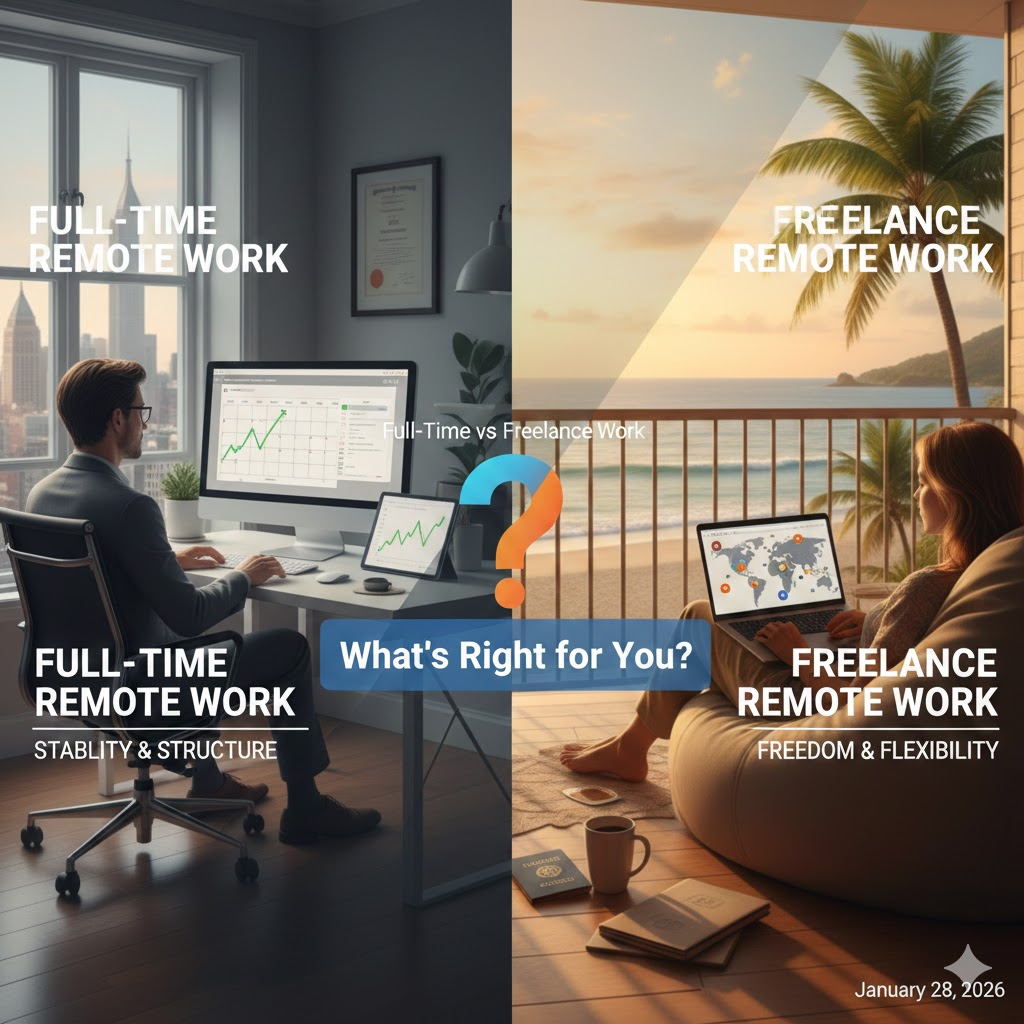
Remote work has expanded beyond a single model. Today, professionals can choose between full-time remote roles and freelance remote work, each offering distinct benefits and challenges. The right choice depends on your career goals, financial needs, work style, and appetite for flexibility or stability.
This guide breaks down the differences between full-time and freelance remote work to help you decide which path aligns best with your priorities.
Understanding Full-Time Remote Work
Full-time remote work means being employed by a company on a permanent or long-term basis while working entirely or primarily from home. You typically follow company schedules, processes, and expectations, even though you are not physically present in an office.
Key Characteristics of Full-Time Remote Roles
- Fixed salary or annual compensation
- Consistent working hours
- Long-term role stability
- Company-provided tools, benefits, and structure
Full-time remote employees often operate like in-office staff, just without the commute.
Understanding Freelance Remote Work
Freelance remote work involves providing services to clients on a project or contract basis. Freelancers are independent professionals responsible for finding work, managing clients, and handling their own finances.
Key Characteristics of Freelance Remote Work
- Income varies by project or client
- Flexible schedules
- Multiple clients at once
- Full control over workload and pricing
Freelancing offers autonomy but comes with added responsibility and uncertainty.
Income Stability and Financial Security
One of the biggest differences between full-time and freelance remote work is income predictability.
Full-time remote roles provide steady monthly income, which makes budgeting, saving, and long-term financial planning easier. Benefits such as health insurance, paid leave, and retirement contributions often add extra financial security.
Freelance income can fluctuate based on workload, client availability, and market demand. While high-earning freelancers may out-earn full-time employees, income gaps and late payments are common challenges.
If financial stability is a priority, full-time remote work often feels safer.
Flexibility and Work-Life Control
Freelancers typically enjoy greater flexibility. They can choose projects, set their own schedules, and decide how much or how little to work. This is ideal for those who value autonomy or need non-traditional hours.
Full-time remote employees usually have set working hours and meeting schedules. While flexibility exists, it is often limited by company expectations and time zones.
If controlling your daily routine matters more than consistency, freelancing may be the better option.
Career Growth and Skill Development
Full-time remote roles often offer structured career progression. Employees may receive mentorship, training programs, promotions, and performance-based raises.
Freelancers develop skills through diverse projects and industries. However, career growth is self-directed. There is no formal promotion path, and learning investments come out of pocket.
Those who prefer guided growth may lean toward full-time roles, while self-motivated learners may thrive as freelancers.
Benefits and Perks
Full-time remote positions commonly include:
- Paid time off
- Health and wellness benefits
- Learning budgets
- Home office stipends
Freelancers must fund their own benefits, including insurance, equipment, and time off. While rates can be adjusted to cover these costs, it requires careful financial planning.
Benefits often play a decisive role for professionals with families or long-term financial commitments.
Job Security and Risk
Full-time remote employees generally enjoy more job security, although layoffs can still happen. Employment contracts and notice periods offer some protection.
Freelancers face higher risk due to client dependency. Losing a major client can significantly impact income. Diversifying clients helps, but risk remains part of the model.
Your tolerance for uncertainty should heavily influence your decision.
Workload and Boundaries
Freelancers control their workload but often struggle with boundaries. Overbooking, scope creep, and client demands can lead to burnout.
Full-time remote employees usually have defined responsibilities, but may face meeting overload or after-hours expectations.
Both models require discipline, but freelancing demands stronger self-management.
Taxation and Administration
Freelancers handle:
- Invoicing
- Taxes
- Contracts
- Expense tracking
Full-time employees usually have taxes deducted automatically and minimal administrative work.
If you prefer simplicity, full-time remote work reduces administrative overhead.
Which Option Is Right for You?
Full-time remote work may be right if you:
- Prefer predictable income
- Value benefits and job security
- Want structured career growth
- Enjoy working within teams
Freelance remote work may be right if you:
- Value flexibility and independence
- Want control over projects and clients
- Are comfortable with income variability
- Enjoy entrepreneurship and self-management
Some professionals transition between both at different career stages.
Can You Combine Both?
Many remote professionals start freelancing while working full-time or take contract roles between jobs. Hybrid approaches allow you to test freelancing without fully committing.
However, always review employment contracts for exclusivity clauses before combining both models.
Frequently Asked Questions
Is freelance remote work more profitable than full-time roles?
It can be, but income is less predictable. High earnings often come with increased responsibility and risk.
Is full-time remote work more secure?
Generally yes, especially when combined with benefits and long-term contracts.
Which is better for beginners?
Full-time remote roles are often better for beginners due to structured learning and mentorship.
Can freelancers get long-term stability?
Yes, through long-term contracts and retainer clients, though stability requires effort and planning.
Can I switch between the two later?
Absolutely. Many professionals move between full-time and freelance work as their goals evolve.
Final Thoughts
There is no universal answer to full-time vs freelance remote work. The right choice depends on your financial needs, risk tolerance, career goals, and lifestyle preferences.
Remote work offers flexibility in more ways than one. Whether you choose stability or independence, success comes from aligning your work model with what matters most to you.